
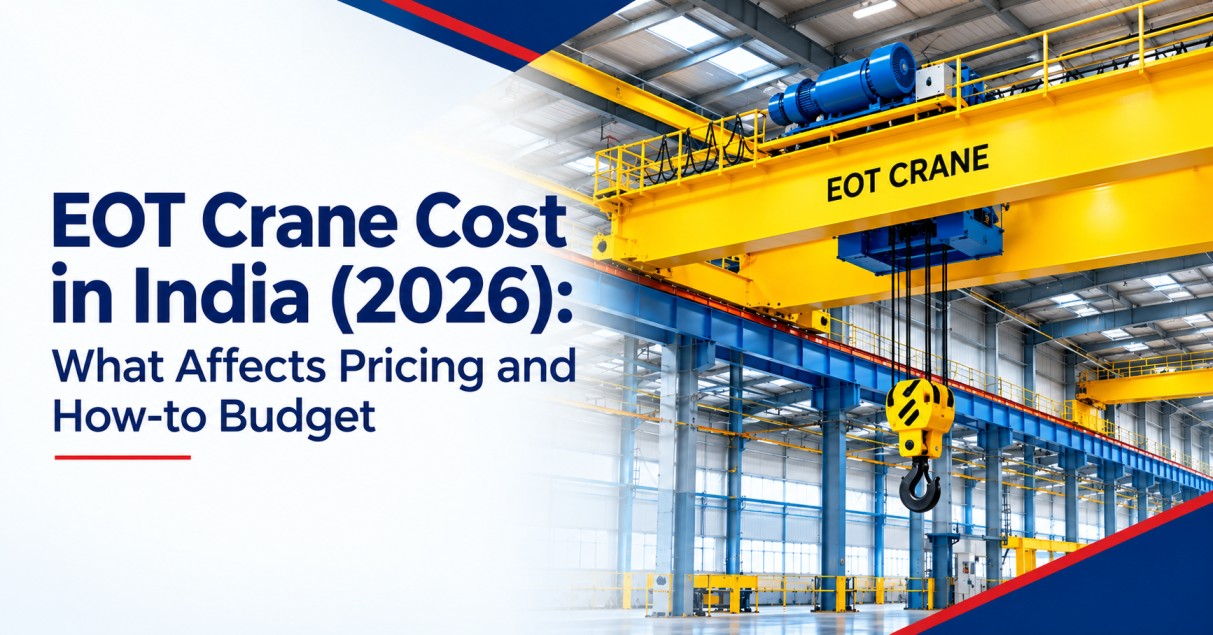
While building or upgrading a material handling system, understanding the true EOT crane cost in India is essential for accurate industrial capital expenditure (CapEx) planning. Electric Overhead Travelling (EOT) cranes are workhorses across manufacturing facilities, warehouses, fabrication yards, engineering units, and heavy construction sites.
However, calculating the total price in 2026 goes beyond equipment purchase price alone. It requires analyzing load parameters, duty cycles, site infrastructure, and total cost of ownership (TCO).
What Is an EOT Crane?
An EOT crane (Electric Overhead Travelling Crane) is an electrically operated overhead system designed to lift and transfer heavy loads horizontally and vertically across a designated bay.
Key structural and mechanical components include:
- Bridge Girder & End Carriages: The primary load-bearing horizontal span and wheel assemblies.
- Lifting & Travel Mechanisms: The electric hoist/trolley, cross-travel drive, and long-travel drive.
- Controls & Electrical Systems: Control panels, festoon cable systems, and pendant/radio remote controls.
- Safety Assemblies: Limit switches, overload protectors, anti-collision sensors, and emergency brakes.
Estimated EOT Crane Price Range in India (2026)
Because every crane is custom-engineered to match specific facility layouts and operational demands, off-the-shelf pricing does not exist. However, the general market baseline starts from a few lakh rupees for basic light-duty units and scales upward depending on complexity.
The following estimates provide a general benchmark for budget planning:
|
Crane Configuration |
Load Capacity Range |
Typical Span Range |
Estimated Investment Range (INR)* |
|
Single Girder EOT Crane |
1 Ton – 10 Ton |
Up to 20 meters |
₹2.5 Lakh – ₹12 Lakh |
|
Double Girder EOT Crane |
5 Ton – 50+ Ton |
15 to 35+ meters |
₹10 Lakh – ₹45+ Lakh |
|
Heavy Duty / Custom EOT |
50+ Ton |
Custom engineered |
Quotation based on spec |
Note: Figures are market estimates for core equipment. Final turnkey costs depend on duty classification (e.g., IS 3177 / FEM standard ratings), hoist specifications, VFD drives, and runway installation scope.
Key Factors That Influence EOT Crane Pricing
1. Load Capacity & Span Requirements
- Lifting Capacity: Higher tonnage demands thicker structural steel, heavier hoist machinery, larger gearboxes, and higher-torque motors. A 5-ton capacity crane requires vastly different structural framing than a 50-ton setup.
- Crane Span: The distance between the runway rails directly affects the length and reinforcement of the bridge girder. Longer spans require engineered box girders to prevent deflection, increasing material costs.
2. Single Girder EOT Crane vs. Double Girder EOT Crane Design
Choosing the right structural design balances upfront cost against vertical hook clearance and duty demands:
|
Feature |
||
|
Primary Use |
Light to medium industrial applications |
Heavy-duty, high capacity, and wide spans |
|
Upfront Cost |
Economical initial investment |
Higher initial investment due to structure & dual girders |
|
Headroom / Hook Height |
Standard hook height |
Maximizes hook height and vertical lift clearance |
|
Maintenance |
Simpler maintenance profile |
Requires comprehensive structural and rail checks |
3. Duty Classification (IS Standards & Frequency)
Operating frequency directly dictates mechanical component ratings. A crane running twice an hour requires different drive systems than one running continuously in a 24/7 steel plant. Higher duty classes require:
- High-power, inverter-duty motors
- Heavy-duty gearboxes and fail-safe braking systems
- Thermally rated electrical components and heavy structural steel
4. Hoist Mechanisms, Drives, and Automation
Advanced control technology increases initial outlay but significantly reduces long-term maintenance and wear:
- Variable Frequency Drives (VFDs): Provide smooth acceleration/deceleration, minimizing load swing and gear wear.
- Safety & Control Upgrades: Wireless radio remotes, anti-collision sensors, load-cell display indicators, and automated limit switches enhance job site safety.
Planning an EOT Crane Project for Your Facility?
Avoid costly over-specification or under-designed infrastructure. The engineering team at Sumo Material designs custom, cost-optimized EOT cranes tailored precisely to your operational duty, span, and budget.
[Contact Sumo Material for a Custom Quotation]
Hidden Costs to Include in Your Project Budget
Purchasing the crane machinery is only part of the capital expenditure. To avoid budget overruns, factor in these essential project costs:
- Runway Infrastructure & Gantry Steelwork: Installation of supporting columns, gantry beams, and runway rails if your building lacks integrated support.
- Electrical Integration: Main power line systems (DSL busbars), cable trays, control panels, and primary power drops.
- Logistics & Freight: Transportation of oversized girders to the site.
- Site Assembly & Rigging: Mobile crane rentals, rigging crews, mechanical assembly, and wiring.
- Testing & Commissioning: Full load testing, deflection checks, and safety sign-offs prior to operation.
- Preventive Maintenance: Routine service schedules to ensure long-term uptime and prevent costly production shutdowns.
6 Steps to Prepare an Accurate EOT Crane Budget
Rather than shopping by base price alone, follow an application-first budgeting framework:
- Determine Maximum Rated Load: Identify peak lifting requirements rather than average daily loads.
- Measure Operational Space: Accurately measure span width, available building headroom, runway length, and required hook approach.
- Define Operational Duty: Estimate operating hours per day and cycles per hour to select the proper duty class.
- Select Structural Design: Decide between single girder or double girder based on headroom and tonnage needs.
- Specify Controls & Safety Features: Identify necessary additions such as radio remotes, VFDs, overload protection or anti-collision device.
- Request Comprehensive Turnkey Quotes: Ensure quotes cover equipment, transport, installation, testing, and warranty terms.
How to Reduce Costs of EOT Crane Without Sacrificing Quality
-
Avoid Over-specifying: Match the crane capacity and duty class closely to actual requirements rather than over-engineering unnecessarily.
- Focus on Total Cost of Ownership (TCO): High-quality VFDs, motors, and electrical controls lower long-term power consumption and maintenance costs.
- Prepare the Worksite Early: Precise site measurements prevent costly delays during rail alignment and crane erection.
- Partner with an Experienced OEM: Working with an established manufacturer ensures compliance with engineering codes, reliable component sourcing, and dependable long-term aftermarket support.